Your Clothes Need Different Kinds of Care
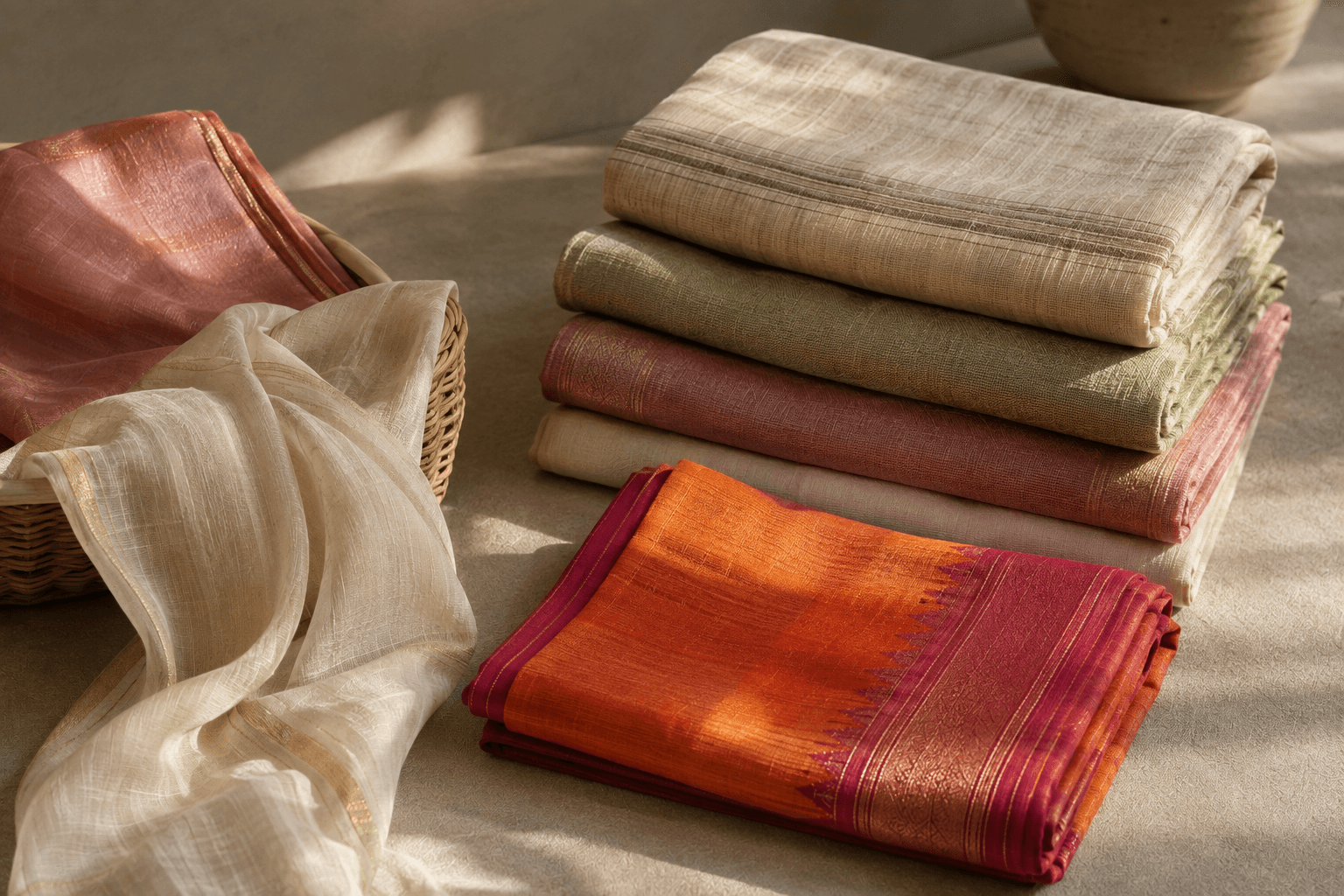
Caring for What You Own
A linen shirt and a mul cotton saree may both feel light and comfortable.
But they don’t necessarily want to be washed, dried or stored in the same way.
We often treat clothing as though it were all made from the same thing.
Put everything in the wash.
Add detergent.
Dry it.
Fold it.
Put it away.
Repeat.
But fabrics have different personalities.
The way a garment is made, the fibres it contains, the weave, the dye and any finishing applied to it can all affect how it responds to washing, heat, friction and storage.
And sometimes, clothes don’t become old because they were poorly made.
They become old because we asked too much of them.
Linen doesn’t need to be treated like cotton
Linen has a naturally structured character. It creases easily, and its texture changes with wear.
It doesn’t need to be treated as though every crease is a problem that must be removed.
Gentle washing, appropriate drying and avoiding unnecessary heat can help preserve the fabric over time. And because care instructions can vary between garments, the label or maker’s guidance should always come first.
The goal isn’t to keep linen looking untouched.
It is to let it age well.
Mul cotton needs its own consideration
Mul cotton is delicate and exceptionally light.
Its softness is part of what makes it beautiful, but that also means it can be more vulnerable to rough handling than a heavier cotton fabric.
Aggressive scrubbing, excessive wringing or unnecessarily harsh washing can put more stress on a lightweight fabric.
Gentler handling can help preserve the softness and structure that made you choose it in the first place.
And handloom is not simply another word for “wash carefully”
Handwoven fabrics can have their own characteristics depending on the fibre, weave, dye and finishing.
There isn’t one universal care method for every handloom textile.
A handwoven cotton saree and a handwoven silk saree are not interchangeable just because both came from a handloom.
The loom tells us how the cloth was made.
It doesn’t tell us everything about how the cloth should be cared for.
That distinction matters.
Care is part of a garment’s lifespan
We often talk about buying better clothes as though the story ends at the checkout.
It doesn’t.
The life of a garment continues through every wash, every drying cycle, every time it is folded and stored, and every time it is worn.
Too much heat can affect some fabrics.
Too much friction can weaken or distort them.
Harsh cleaning can affect fibres and colours.
Improper storage can expose textiles to moisture, insects or other forms of damage.
None of this means clothing needs to be treated like something fragile and precious.
It simply means it is worth knowing what you own.
Before washing, pause.
Read the care label.
Look at the fabric.
Think about how it has been made.
If you’re unsure, choose the gentler approach rather than assuming every garment can tolerate the same treatment.
And when something needs specialist care, let the material — not convenience — make that decision.
The small habits matter
A garment doesn’t usually deteriorate because of one ordinary wash.
It is often the accumulation of small things.
A little too much heat.
A little too much detergent.
A little too much friction.
A little too much washing.
Repeated hundreds of times.
The same is true in the other direction.
Gentler washing.
Proper drying.
Thoughtful storage.
Wearing something often, but not abusing it.
Small decisions repeated over years can make a difference.
A well-made garment gives us the possibility of a long life.
Care is what helps us realise it.
Because buying something good is only the beginning.
Keeping it good is part of owning it.