Why Does Linen Crease?
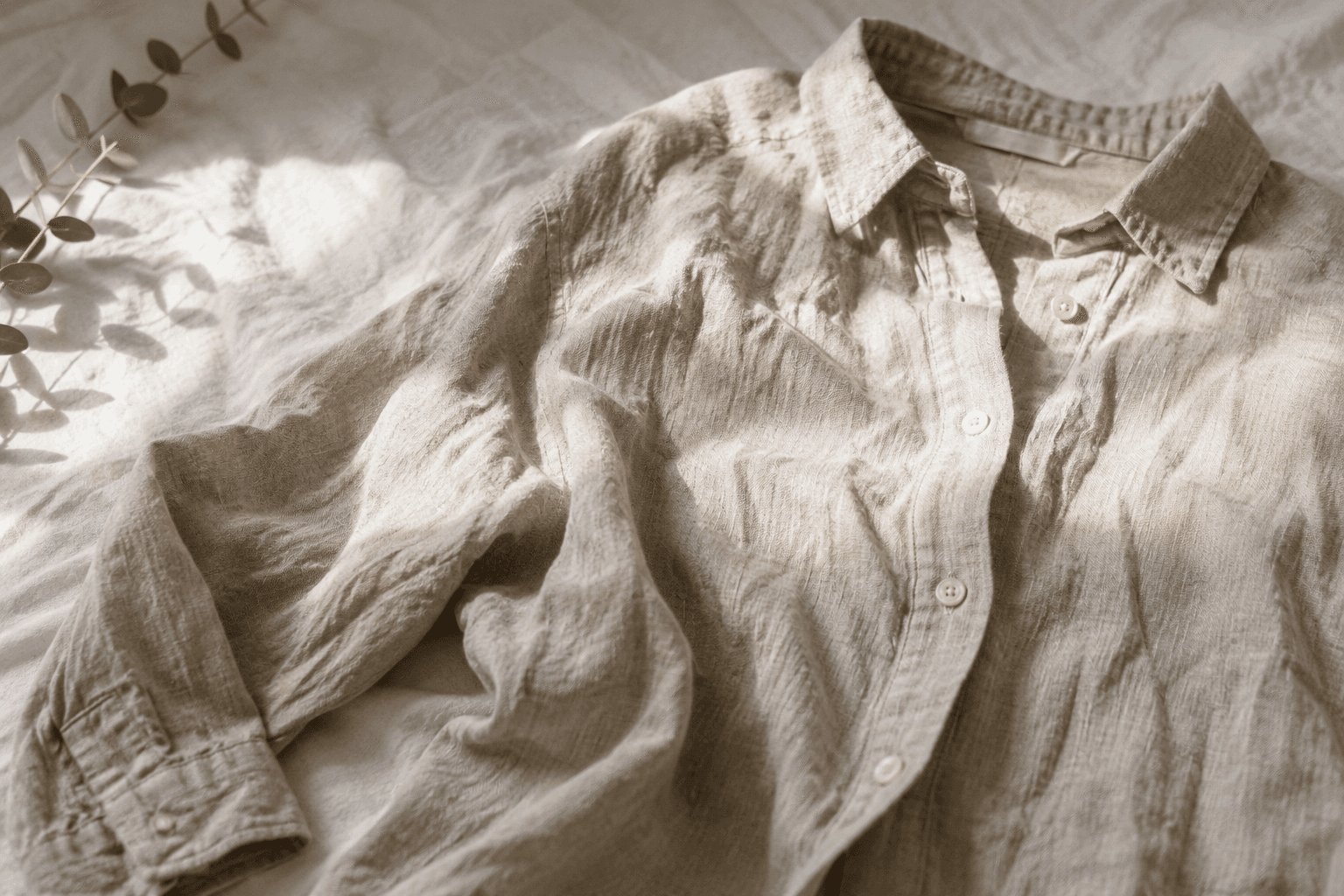
You iron linen.
You put it on.
You sit down.
And there it is again.
The crease.
It can be tempting to think of this as something linen does wrong. But creasing is less a flaw than a characteristic of the fabric.
Linen is made from the fibres of the flax plant. Those fibres are relatively stiff compared with some other common textile fibres, and linen fabric has a particular structure and behaviour that allows it to crease noticeably when it is folded, bent or compressed.
When you sit, move your arms or simply wear a linen garment through the day, parts of the fabric are pushed out of their original position.
The fabric doesn’t always immediately return to how it looked when freshly pressed.
So the creases stay.
This is also why freshly ironed linen and linen after a few hours of wear can look like two slightly different fabrics.
One is crisp.
The other has begun to take on the movement of the person wearing it.
There is another reason linen’s creases can become part of its appeal: they give the fabric texture.
Unlike a perfectly smooth synthetic surface, linen often looks better when it is allowed to retain some of its natural character. The slight rumpling gives it softness visually, even when the fabric itself has a distinctly structured feel.
That doesn’t mean linen should never be ironed.
If you prefer a sharper appearance, you can certainly press it. But it is worth knowing that keeping linen completely crease-free is not really the point.
The crease will return.
And perhaps that is okay.
We often expect clothes to remain exactly as they looked when we bought them. We press away the wrinkles, remove every sign of wear and try to preserve the idea of newness.
But some fabrics were never meant to look untouched.
Linen changes as it is worn.
Its creases are part of that change.
Maybe the better question isn’t:
How do I stop linen from creasing?
Maybe it is:
How much of the fabric’s character am I willing to let remain visible?