What Does It Take to Make One Saree?
A saree can look simple when it is folded on a shelf.
Six yards of cloth. A border. Perhaps a little colour, a little pattern.
But before it becomes something we wear, there is a much longer story.
It begins with fibre.
The fibre is spun into yarn, and that yarn needs to be prepared before it can meet the loom. Depending on the textile, this can involve cleaning, spinning, winding, sizing, dyeing and arranging the yarns in preparation for weaving.
Then comes the loom.
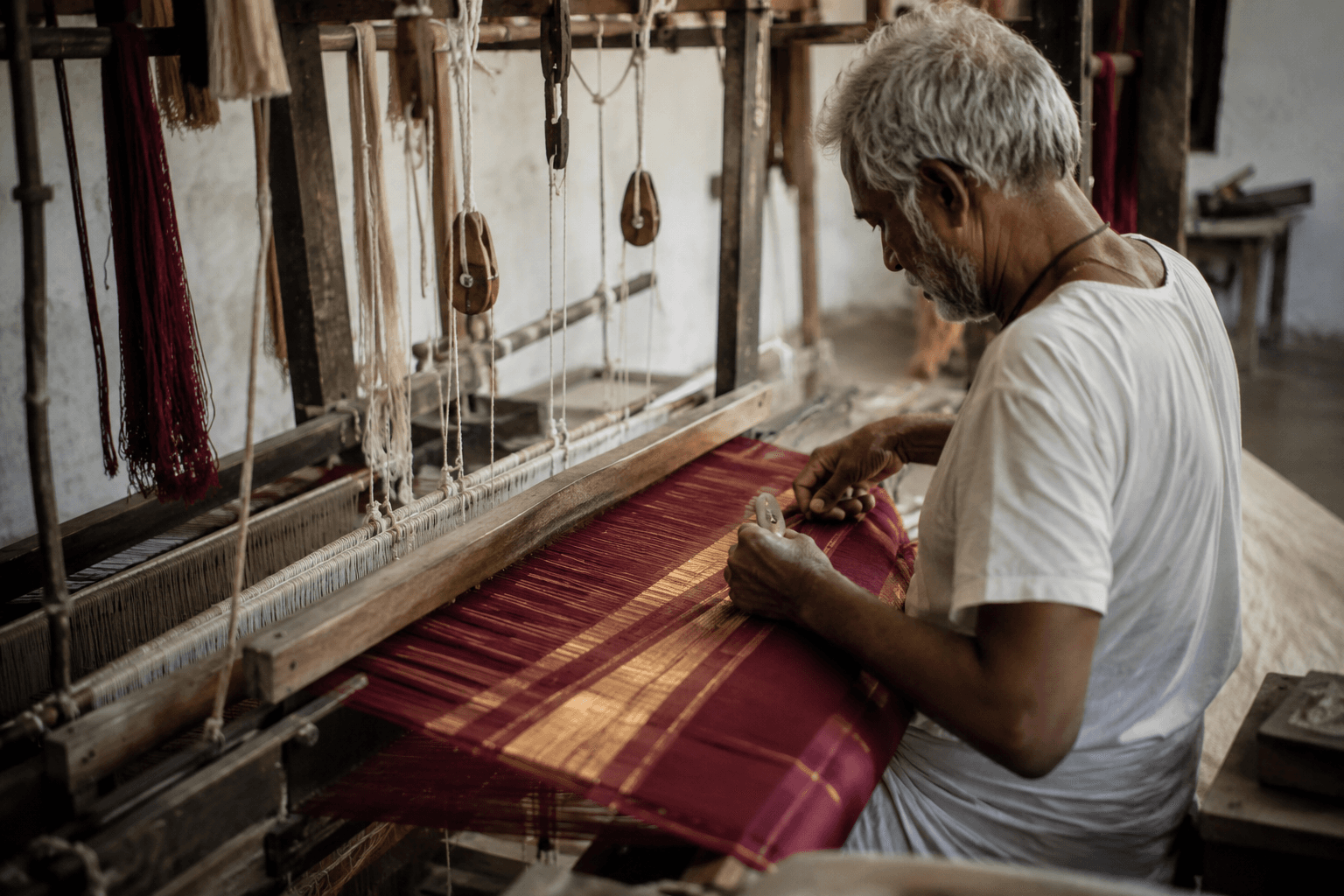
A handloom is not simply a machine that turns thread into cloth. It is a system that has to be carefully prepared before weaving can begin. Threads are arranged in precise order, tensioned correctly and passed through the loom according to the structure and design of the fabric.
Only then does weaving begin.
The weaver works with the warp — the threads running lengthwise — and the weft, which travels across them. With every movement of the loom, another small section of cloth takes shape.
It can look repetitive from a distance.
It isn’t.
The weaver is constantly paying attention: to tension, alignment, pattern, colour and the behaviour of the yarn. A small problem can require adjustment. A change in design may require a different sequence of movements.
And the saree slowly grows.
This is one reason handwoven cloth can carry small variations. A slightly different line. A subtle change in texture. A tiny irregularity in the weave.
These aren’t necessarily mistakes.
They can be evidence of the process itself.
Once the weaving is complete, the saree may still need finishing, depending on the textile and how it has been made. Loose threads are checked, the fabric is prepared, and it is readied for the person who will eventually wear it.
So when we say that a saree takes time to make, we are not talking only about the hours spent at the loom.
We are talking about everything that came before the first thread was woven — and everything that happens after the last one.
The finished saree hides most of this work.
Perhaps that is part of its beauty.
We see a piece of clothing.
Behind it is fibre, yarn, preparation, technique, attention, repetition and time.
The next time you unfold a saree, it may be worth looking at it for a little longer.
Not just as something beautiful.
But as something that had to be made.